No 111: AI's cognitive offloading v cognitive uploading
AI Awareness day, a ChatGPT monoculture, co-existing with AI, cognitive uploading, children's media lives, a Swiss 'ethical AI' and much more...
What’s happening
Welcome back after the half-term break, let’s go straight to the news, views and resources.
AI roundup
AI Awareness Day
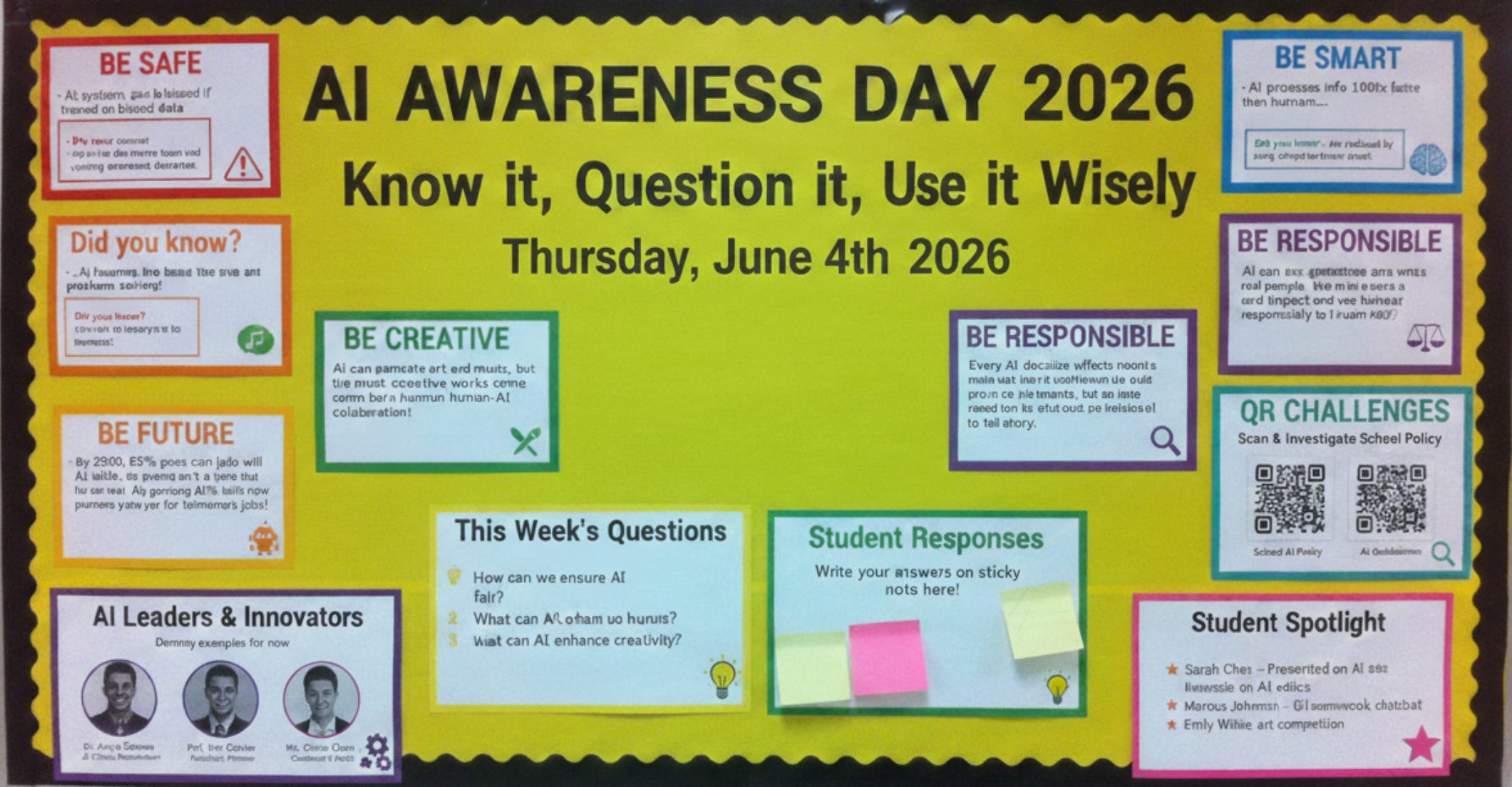
Yesterday was the UK’s first national day dedicated to AI literacy in schools, AI Awareness Day, founded by our former colleague Mark Martin. If you missed it, the resources under the five themes (creative, future, responsible, safe, smart) are still available on the website and include five-minute lesson starters, whole-school assemblies and after-school activities.
What incoming students know about AI
A new ‘pre-arrival academic questionnaire’ from Advance HE, Jisc and UEL is gathering data on incoming students, and the AI responses have been analysed by Rose Luckin. She argues that “the findings could usefully sit on the desk of everyone responsible for AI strategy, curriculum design, access and participation and student transition”, given that while 60.6% report having used generative AI in some form before arriving at university, a full 39% of incoming undergraduates apparently have no experience of generative AI whatsoever. This group worries Luckin – students who arrive without AI experience and then encounter institutional guidance that is contradictory, absent, or pitched at those who already know the landscape are the group most likely to be penalised by that incoherence. She also notes that those who do have AI experience are in a ChatGPT ‘monoculture’ (for most students, AI = ChatGPT) and this “single-tool mental model shapes what they believe AI can and cannot do, what questions they know to ask of it, and how critically they evaluate its outputs.”
Co-existing with AI
Ooooh, it’s an Ethan Mollick blog post. This one’s primarily a long plug for his forthcoming book, but it also looks at some of the huge developments in AI in the two years since his last book and how it’s changed his job (and possibly everyone else’s):
“Two years ago, the question I was trying to answer was how to think alongside a new kind of intelligence. Now the questions are weirder: When should you refuse AI’s help, even when it is offering? When should you hand over the keys entirely? And what do you do when the AI is no longer just your assistant, but your reader, your critic, and the gatekeeper standing between your work and its audience? Writing this book meant living with all three questions at once, and I suspect your job will involve them soon, if it doesn’t already.”
AI and cognitive uploading
Non-fiction writer and NotebookLM fan Steven Johnson is wrestling with similar ideas when he takes UC Berkeley School of Law’s near-outright ban on the use of AI as a kicking off point for an exploration of cognitive offloading versus what he calls cognitive uploading: the ways that AI can get new ideas into your brain, or push your thinking in new directions, or assess your mastery of the material you are trying to understand. He offers various examples of how AI can support cognitive uploading – “One of my most common routines when I am working on an essay or a chapter outline is to share my latest thinking/writing with Notebook, and ask it: what am I missing?” – and argues that AI bans are stuck in the thinking and tech capabilities of 2022 and because, as Mollick suggests, “we don’t have a clear enough picture in our heads yet of what an ideal engagement with AI would look like. What’s the partnership that helps you master the material but also make new connections?”
A different line in the sand
Meanwhile, in the New York Times, Rebecca Winthrop (who led the Brookings Institute’s global taskforce on AI and education) looks at AI’s effect on young people’s thinking and writing – as well as her own. She reports on several studies, including one by a US national research team at Georgetown University led by neuroscientist Adam Green, which has been tracking the range of novel ideas that college-bound high school students present in their application essays, before and since the introduction of ChatGPT. Post ChatGPT, students’ essays suddenly used more diverse and colourful language, but the underlying ideas more often converged into a few homogenised categories. Winthrop also describes her own ‘line in the sand’, which is to always write a first draft herself, before using AI to copy edit.
How AI profits affects school budgets
Flat-rate AI plans are ending, says Dan Fitzpatrick in his latest podcast episode, forcing educators to rethink usage. This shift in edtech pricing will significantly impact school budgets and classroom practice.
Quick links
The Digital Literacies Network has published a new resource for primary schools: Critical thinker online.
Markers of year 6 SATs have been slowed down in their work because of persistent “glitches” in the online system they use.
Barnardo’s has launched a new campaign, Call It What It Is, working alongside children and young people to counter dangerous narratives about misogyny and harmful notions of masculinity. Read the key findings and this Guardian article on the report.
Pair with this TES article on what research tell us about the scale of the ‘manosphere’ and misogynistic content problem and how schools should respond.
For the first time, the G7 has agreed on common principles to protect minors online, directly inspired by the European Commission’s approach to online safety for children.
‘Put your phone away’: Sweden urges parents to restrict their own screen use around children.
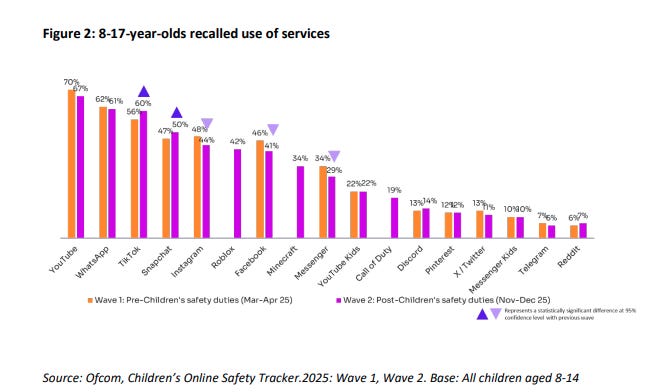
Ofcom’s children’s online experiences report 2026 is out.
The Children’s Commissioner, Rachel de Souza, launched The Big Future, her final national survey as Children’s Commissioner. She has created a stakeholder resource kit containing everything you need to promote The Big Future across your networks.
Pair with this round up of views about the government’s consultation on improving online safety for children
And the all-Party Parliamentary Group (APPG) for Digital Creators warning that a future social media ban must exclude educational content
Ofqual chief regulator Sir Ian Bauckham warns that tech-driven cheating – using devices such as AI-enabled smart glasses and invisible ear pieces – demands “really fast’ action”.
Snapchat reports on how teens are spending their time online.
We’re reading, listening, watching…
Children’s Media Lives
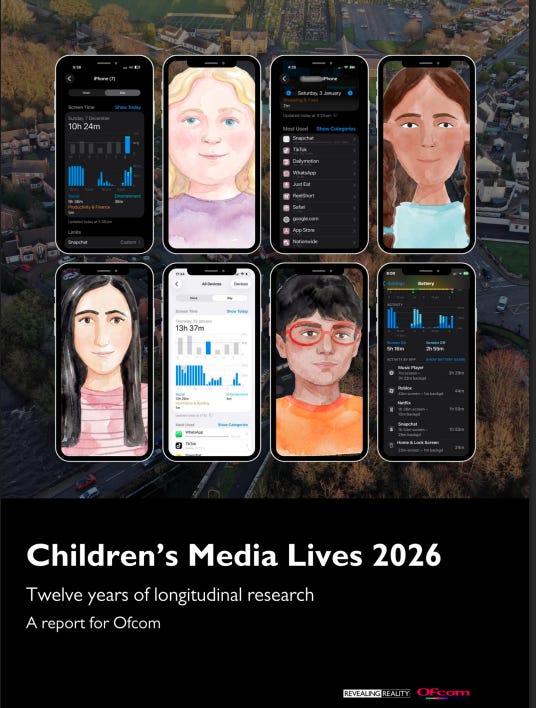
Children’s Media Lives is a longitudinal qualitative research project, first commissioned by Ofcom in 2014, to explore how children aged 8–17 in the UK engage with media. The project aims to visit the same participants each year, providing insight into how their media use, behaviours and attitudes change over time, alongside developments in the wider media landscape. Key findings from this edition include:
The children are growing up in an increasingly online, individualised media environment
Offline media and activities play a diminishing role in the children’s everyday lives
The children’s media consumption is increasingly fragmented, with less emphasis on shared narratives or context
AI has become an established and integrated tool used by most of the children, as well as being present in the content they consume on social media
Commercial content is embedded within children’s online environments and is not always recognised as marketing
Digital technology is shaping what and how the children are learning
Gaming remains an important form of entertainment and social interaction
The children’s social media use is centred on content consumption, with more limited active interaction
Why context and culture matter in youth online safety
In this episode of the Hello World podcast, Doctor Karla Badillo-Urquiola, Assistant Professor at the University of Notre Dame, discusses her research into adolescent online safety and what it can teach us about creating safer, more inclusive digital learning experiences.
Switched on to privacy: chat, choose, check
Katie Searle, Director of Children’s Strategy at the Information Commissioner’s Office (ICO), the UK’s independent regulator for data protection and information rights is on Parent Zone’s Tech Shock’s podcast. ICO’s new Switched On to Privacy campaign is designed to help parents start regular, practical conversations about online privacy. This episode explores what a child’s data trail looks like, where the risks lie, and what families can actually do about it.
Give it a try

Euria
Euria bills itself as the “ethical AI assistant”, with a focus on confidentiality, security and a pledge to use 100% renewable energy. The company is based in Switzerland, as it is part of the Infomaniak ecosystem, which is 100% Swiss.
Connected Learning is by Sarah Horrocks and Michelle Pauli