No 114: Digital, AI and SEND
Digital technology and SEND, environmental impact of AI, another AI literacy framework, AI and early years, GCSE Computing, Ask and Astronaut and much more...
What’s happening
Last week Sarah ran a workshop on digital technology at the ‘Inclusion Matters: Learning From What Works’ SEND and inclusion conference at the University of Gloucestershire.
The conference was led by Helen Williams and the day opened by Dr Tristan Middleton, Senior Lecturer in Inclusive Education at the University of Gloucestershire. Drawing on his experience as a teacher, SENCo and school leader, his keynote set the tone for the day by asking what ‘special’ really means in inclusive practice and what teachers and school leaders can do to make a genuine difference for individual learners through relational practice. Tristan’s keynote also put SEND in its sociopolitical and historical context, tracing some of our current challenges to policy decisions, beliefs and ideologies.
Sarah’s session covered several digital technology themes, and drew on the SEND network CPD programme that she worked on with colleagues in Camden and sharing of practice in Gloucestershire schools. Discussions covered:
How digital literacy is an inclusion, equity and entitlement issue for all children and young people. For pupils with SEND, this entitlement is even more pressing. Where disability, special educational needs or other disadvantages already create barriers, low digital skills, limited access to devices, lack of confidence with technology and low digital and media literacy can compound existing disadvantage
The overlooked power of accessibility features already built into devices and platforms, whether it is text-to-speech software or specific hardware settings. SENCos agreed that teachers and TAs need more training and the policy support to use these tools effectively.
How important it is for teachers to understand Universal Design for Learning (UDL) principles as part of inclusive teaching when designing slides and other digital materials. UDL is about more than accessibility for students with SEND; it’s about creating flexible, diverse learning pathways that foster autonomy, reduce learner frustration and build a truly inclusive environment for every student in the classroom.
Quality assurance for interventions: schools often lack a systematic approach to evaluating online interventions. We need to move beyond off-the-shelf solutions and look for evidence-based practice.
Generative AI offers potential to support inclusion through tasks such as summarising, chunking information, creating scaffolds such as writing frames, knowledge organisers, sentence starters, translation – live or prepared, differentiation through reading age, dual coding through visual and audio materials, audio to text recording and summarising, audio descriptions of images and dealing with (AI generated) parent communication. However, innovation must be balanced with rigorous data governance.
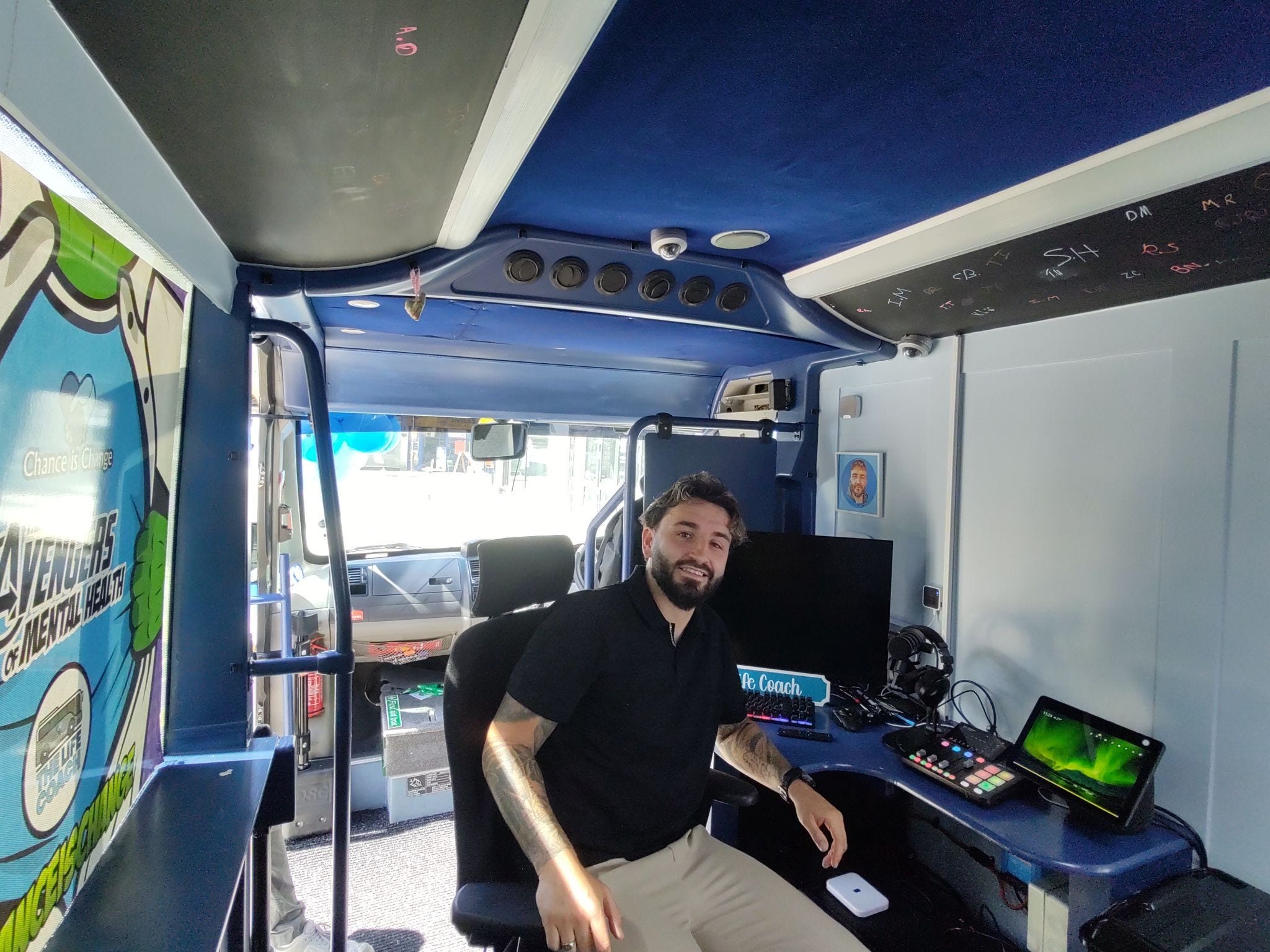
A wide choice of workshops through the day spanned a range of SEND themes. Emotional wellbeing and pupils’ sense of self featured prominently. Tom Hoskins, founder of Chance is Change, shared his work supporting children’s belonging and agency through his new publication Welcome to Feelings Town. His Life Coach bus was also available for delegates to visit and explore throughout the day, giving a hands-on flavour to his work with individual pupils.
AI roundup
Guide to the environmental impact of AI
Jisc and the Environmental Association for Universities and Colleges (EAUC) have launched a practical guide to help universities and colleges address the environmental impact of AI in post-16 education and research. The core issue is that AI adoption is outpacing institutions’ ability to understand its environmental consequences, with sustainability considerations often missing from AI policy conversations. Key challenges include lack of transparency from technology providers about energy and carbon outputs, plus electronic waste from hardware manufacturing and disposal. But AI can also support sustainability goals when used thoughtfully – optimising campus energy use, supporting climate research, automating carbon accounting, and extending equipment lifespans through predictive maintenance. The guide recommends institutions audit their AI use, ask suppliers the right questions about environmental impact, integrate environmental literacy into staff training, and strengthen governance around AI’s sustainability implications. Jisc and EAUC are also offering a masterclass on 14 July and providing practical tools to help institutions embed sustainability into procurement and decision-making.
Updated European Commission OECD AI literacy framework
The OECD and European Commission have published a new AI literacy framework for primary and secondary education, recognising that AI is increasingly embedded in digital life, often invisibly shaping real-world outcomes. The framework defines AI literacy as a set of knowledge, skills and attitudes that equip learners to understand how AI systems work, critically evaluate their outputs and use them ethically and creatively. Its goal is to support informed decision-making about the opportunities and risks that AI presents. The publication establishes a common framework outlining desired outcomes for primary and secondary learners, and guides stakeholders in supporting those outcomes both inside and outside the classroom. It’s designed to help education systems across different countries equip young people for an AI-shaped world.
AI’s place in early years education
Matt Weymss had a chat with early years teacher Poppy LeMar to find out what AI looks like with four and five year olds. Reassuringly, perhaps, the first point she makes is that, with early years, the technology is for the staff, not the children. She then goes on to describe some real-world situations – for example, a prompt to produce ideas for how to theme activities around whatever the children are into that week:
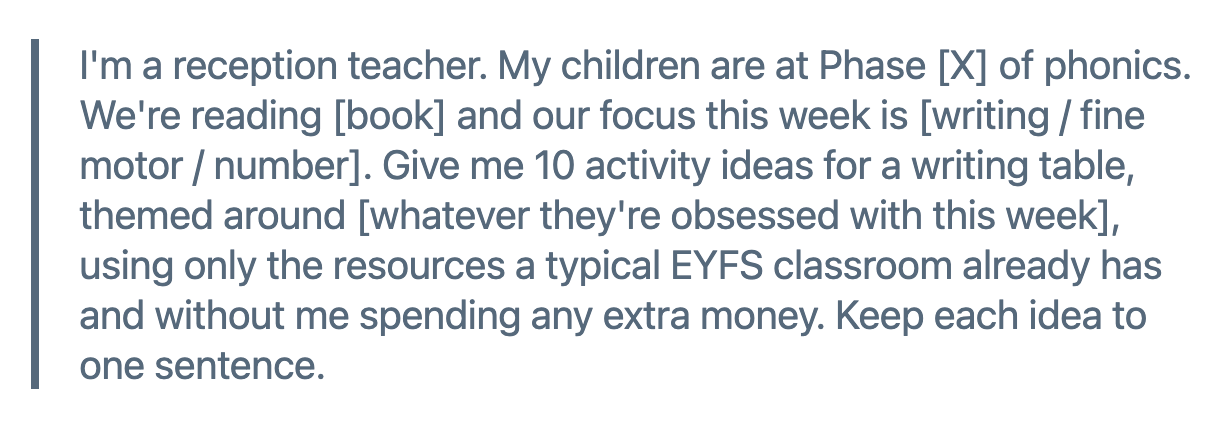
There’s also a suggestion for coding ‘intervention games’: small, bespoke apps for number, pattern, sound recognition and the tricky non-phonetic words, pitched at different ability levels.
See also Katy Potts’ post on the key principles set out in the Digital Pedagogy section of Birth to 5 Matters Early Education guidance.
Quick links
The Computing at School (CAS) working group has published proposals for a new GCSE Computing. Thanks to Miles Berry for sharing.
Scouts are introducing new badges in content creation, AI, digital communication and online safety.
The National Literacy Trust has a new report on writing for pleasure. Could the tide be turning for writing enjoyment among children and young people? Scores have risen modestly after reaching a 15-year low in 2025.
The Full Fact report assesses the precarious state of the UK’s information environment, focusing on growing uncertainty about what to trust and the serious impact this is having on democracy.
The Guardian reports on the success of a hybrid school, and questions whether clampdowns on screentime puts innovative systems like LPS Hybrid at risk. It also reports that four in five teens in Australia are still using social media.
Ofcom has published recommendations for broadcasters and online platforms on promoting media literacy.
We’re reading, listening, watching…
My Friend Flicker?
Common Sense Media has produced a report which explains attention capture; how visual pacing affects children’s attention, learning, and cognitive development. Attention Capture is measured using a metric called flicker, a computer vision measure of how rapidly and dramatically the visual scene changes from frame to frame. Rapid scene cuts, high-contrast colour shifts, sudden motion, and constant visual complexity all drive up a video’s flicker score. The higher the score, the more visually stimulating the content.
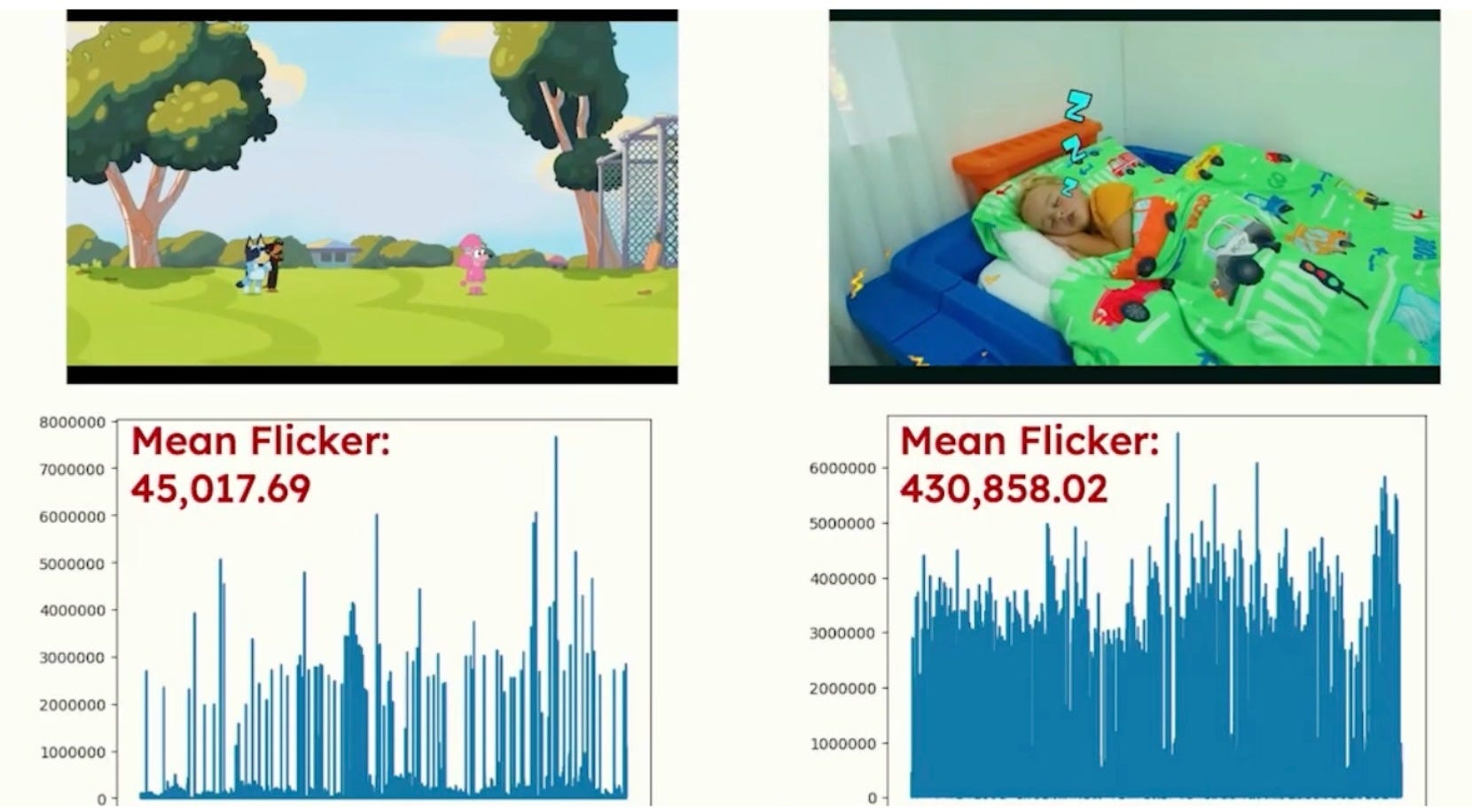
Flicker is an objective measurement, similar to how a decibel meter measures volume without rating a song. What matters is whether that level of visual stimulation is appropriate for a child’s age and stage of development.
Bluey has a mean flicker score of 45,017. A video on a popular channel like Niki & Vlad video scores 430,858, nearly 10 times higher. Research links scores in this range to measurable reductions in executive function in young viewers.
Life online: power, risk and resistance
This week’s episode of Start the Week on BBC Radio 4 looked at how life online has reshaped society in real life. The filmmaker Baroness Beeban Kidron exposes how digital platforms exploit and divide in her book Users: How Big Tech Took Control and How to Fight Back. In Little Blue Dot the journalist Katherine Dunn explores how GPS shapes so many aspects of everyday life, from dating and supermarket shopping to global trade and navigation. The Indian novelist Meena Kandasamy talks about Fieldwork as a Sex Object, an exploration of online misogyny, deepfakes and digital mob violence.
People power
David Runciman talks to Wikipedia founder Jimmy Wales at the Cheltenham Science Festival about what we can learn from the astonishing success of this massive experiment in human democratic collaboration – and what might happen to Wikipedia in the AI era.
‘You can’t make billions without hurting people’
This week’s Guardian ideas interview is a frenetic foray into Cory Doctorow’s views on AI as a ‘conjuring trick’, Elon Musk and what the AI bubble means for everyone.
Give it a try
Has every question you could ask an astronaut already been asked?
Ask an Astronaut is a searchable archive of real questions asked of NASA astronauts during in-flight interviews, press conferences and student Q&A sessions aboard the International Space Station, spanning more than two decades of human spaceflight. The About page lays out nicely how it all works.
Connected Learning is by Sarah Horrocks and Michelle Pauli