What's vibe coding - and why?
Feeling the vibes, testing Gemini 2.5, free Darren Coxon AI and revision book, trashing IP, media literacy inquiry, AI and writing, and much more...
What’s happening
The term may only have been coined a few weeks ago but it seems like ‘vibe coding’ is suddenly everywhere. So we thought we’d take a quick look at what it covers and what it means, if anything, for education. The term is credited to Andrej Karpathy in this X post, where he said:
“There's a new kind of coding I call "vibe coding", where you fully give in to the vibes, embrace exponentials, and forget that the code even exists. It's possible because the LLMs (eg Cursor Composer w Sonnet) are getting too good.”
As Karpathy suggests, vibe coding is using AI tools, including LLMs such as ChatGPT, to produce all the code for an app or tool rather than the AI simply assisting someone who already knows how to code.
Ethan Mollick describes it more poetically as “speaking things into existence” and successfully produced a 3D blocky game created using…English. However, while he is fairly chuffed with his game and then with another use case he describes, involving a large dataset, analysis and an academic paper, which “took less than an hour to create, as compared to weeks of thinking, planning, writing, coding and iteration,” he acknowledges the need for human input and collaboration throughout:
“vibecoding isn't about eliminating expertise but redistributing it - from writing every line of code to knowing enough about systems to guide, troubleshoot, and evaluate. The challenge becomes identifying what "minimum viable knowledge" is necessary to effectively collaborate with AI on various projects.”
And this is why schools shouldn’t be rushing to abandon coding or dissuade young people from pursuing software engineering degrees – or not yet, anyway.
Simon Willison points out that the job of a software developer is not (just) to churn out code and features. Professional code needs to work and be understood by others and has to take into account performance, accessibility, security, maintainability, cost efficiency.
He urged everyone to experiment with vibe coding to automate tedious tasks and on low-stakes projects but
“My golden rule for production-quality AI-assisted programming is that I won’t commit any code to my repository if I couldn’t explain exactly what it does to somebody else. If an LLM wrote the code for you, and you then reviewed it, tested it thoroughly and made sure you could explain how it works to someone else that’s not vibe coding, it’s software development. The usage of an LLM to support that activity is immaterial.”
The discussion around vibe coding reminds us of Jane Waite’s Computer Science Student-Centred Instructional Continuum (CS-SCIC), which she created to help teachers understand their choices when designing learning activities for teaching programming.
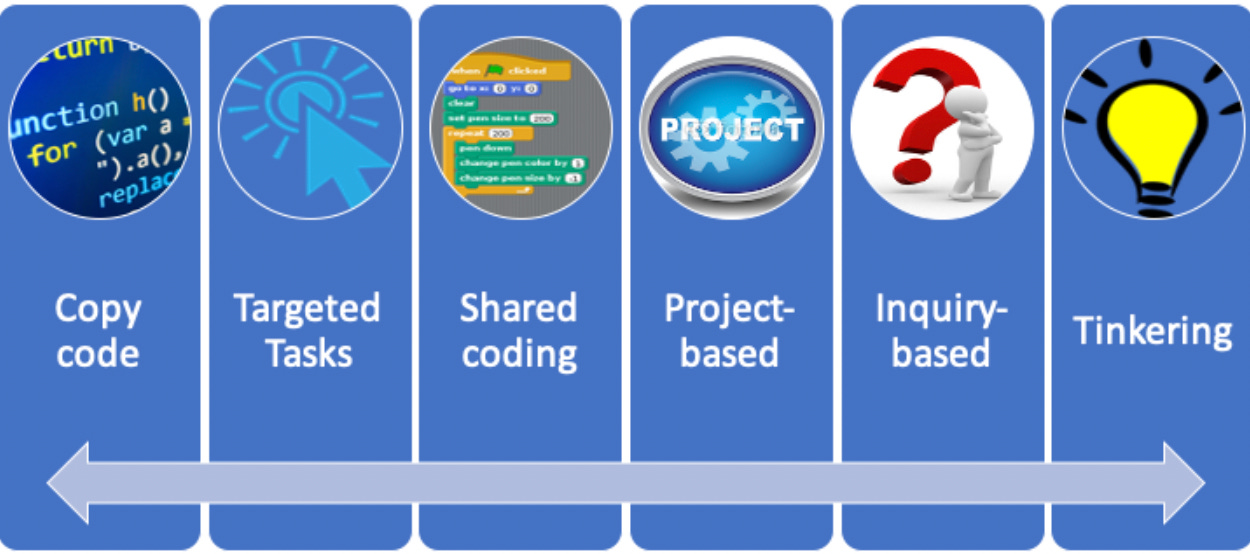
CS-SCIC presents teaching approaches ranging from copy code to tinkering in a simple linear form, moving from more structured activities to more open-ended, student-led exploration. In vibe coding, if the LLM is at the copy code end, where’s the student?
AI roundup
Testing Gemini 2.5
Google has launched Gemini 2.5, its ‘most intelligent’ reasoning model, this week and educators have been having a play with it. Jack Dougall points to some tools that could be useful in school life in this video, including turning any document into a short audio summary, using Gems to build a report assistant that writes in your voice, and building classroom games with no need to code. Darren Coxon has explored how, from a simple prompt, Gemini created a quiz generator that you can add any text-based quiz to, to turn the text into an interactive, digital, self-marking, downloadable version. However, Victoria Hedlund notes that Gemini 2.5 is as biased as Copilot when it comes to images of physicists.
OpenAI has released 4o image generation.

Media literacy inquiry
Given the rise in AI tools and noting that less than a third of adults are confident they can identify AI-generated content, the UK Parliament’s Communications and Digital Committee has launched an inquiry into media literacy in the UK. This inquiry will seek to establish a clear vision for what good media literacy would look like in the UK, and examine the barriers to achieving this vision. Written contributions are welcome – deadline 11 April.
Free AI and revision book
Darren Coxon is offering free copies of his new book on using AI for revision for a few more days. Go to the website and use the coupon code: STUDYSMARTFREE.
Experience AI training
Experience AI is an education programme that teaches students aged 11-14 about AI and machine learning. Parent Zone has partnered with the Raspberry Pi Foundation to deliver free training to UK educators, including remotely.
Adversary or mirror?
In a recent post, Philippa Hardman tackles the problem of increasingly powerful AI agents that autonomously complete online learning courses. She argues that it’s not an integrity problem but a learning effectiveness problem – if an AI can "learn" your material without actually learning anything, what exactly are your human learners getting from the experience? Rather than ditching online learning or creating new consequences for using AI agents to complete courses, she says
“Instead, the future lies in redesigning online learning around real-world skill application, authentic competency assessment and continuous reinforcement.”
IP? What’s that then?
If you’re wondering why your social media feeds are suddenly full of bad Studio Ghibli memes, it’s because whereas previously ChatGPT would refuse Studio Ghibli prompts because of intellectual property rights, it now…doesn’t. Meanwhile, authors remain furious at the discovery that Meta used a massive “shadow library” – The Library Genesis (LibGen) dataset that originated in Russia and contains more than 7.5m pirated books – to train its AI for free. The Atlantic has created a handy tool to check if your book was used in this way.
Quick links
T-level cuts: we’ve been involved with schools preparing for the media, broadcast and production T-level and have followed the twists and turns of vocational qualifications over the decades, so we’re wondering what the Department for Education cuts will mean for T-levels due to low student recruitment. The DfE expects to spend £1.247 billion on the new technical qualifications by the end of the 2024-25 financial year, half a billion less than planned, and have cancelled six planned T-levels. This is the backdrop for today’s NAO report finding that T- levels are still less popular and more expensive than BTecs.
Views sought: meanwhile, the DfE is consulting on its vision for narrowing the digital divide in schools and colleges.
Crossing divides: will it mention the minimum digital standard of living? This standard includes having accessible internet, adequate equipment, and the skills and knowledge people need. It is about being able to communicate, connect and engage with opportunities safely and with confidence (h/t Cliff Manning).
No social media bans: the youth select committee of the UK youth parliament, which is made up of 14- to 19-year-olds, examined written evidence from teens across the UK as well as from experts and concluded in its report that a social media ban for teenagers would not be practical or effective but tech companies should do more to protect young people.
We’re reading, listening…
What does AI mean for writing?
How important is the process of writing as opposed to the end result? In education it’s everything, argues John Warner in a new book, here reviewed by Nick Hillman in HEPI. He says that “writing is thinking” because “the idea may change based on our attempts to capture it”. It’s a view echoed by Alicja Syska in a recent LSE HE Blog post, except that she can also see a role for AI:
“If we can find a sustainable way to use AI as Socratic service that questions, prompts, and encourages deeper engagement with the content, and offers feedback on ideas and argument, style, and voice, but not to appropriate the exact words or answers it comes up with, then we have a chance to use it to learn and grow, rather than reduce learning gains.”
Give it a try

draw.io
draw.io is free online diagram software for making flowcharts, process diagrams, org charts, and network diagrams.
Connected Learning is by Sarah Horrocks and Michelle Pauli