Why aren't girls taking computer science?
The number of girls taking computer science GCSE plummets, what it means to be literate in the AI age, the rise of AI friendship apps, and much more ...
What’s been happening
Last week we reported on the decline of digital skills across school phases and teachers’ concerns that an over emphasis on programming rather than broader digital creativity at primary and secondary level was exacerbating the problem by narrowing the curriculum at KS2 and KS3.
Now, a report from King’s College London has underlined the issue, calling for more digital making opportunities for young people and highlighting that the number of girls taking computer science GCSE has plummeted. It has more than halved in less than a decade, prompting warnings about the “dominance of men in shaping the modern world”.

The sharp decline in female participation follows UK government curriculum and qualification changes that led to the scrapping of the old information communication technology (ICT) GCSE and its replacement with a new computer science GCSE. Schools Week emphasises how Michael Gove hyped his 2014 computing curriculum as being “the end of boring ICT lessons” and a pathway to UK economic success.
The decline of girls choosing computing GCSE or studying STEM subjects in general is a complex area where curriculum design and societal and cultural contexts intersect.
We're impressed by the authors' in-depth exploration of the issue and their resulting six key recommendations.

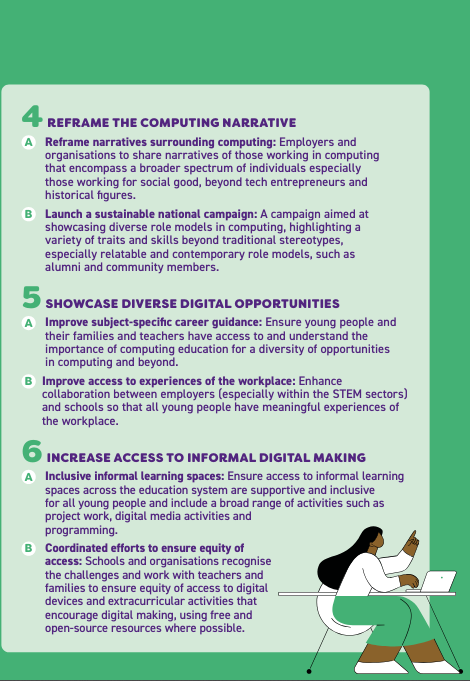
In particular, the recommendations about inclusive environments, diverse environments and careers guidance made us reflect on the work done by Stoet and Geary on the The Gender-Equality Paradox in STEM. Paradoxically perhaps, wealthier and more gender equal countries have fewer women studying and graduating in STEM fields.
We were reminded of a blog post on Engaging Girls in Computer Science by our colleague at the Connected Learning Centre, computing teaching and learning consultant Rowan Roberts. She referenced expectancy value theory in relation to role models to encourage girls and women into STEM, reflections that are still relevant today, especially in light of the recent data and report.
Rowan writes that:
“Role models….are another really important factor in making girls feel that computing careers are attainable for them – but it isn’t just about the women in STEM that are around them. It’s also, as Eccles’ expectancy-value theory suggests, that when girls and women make choices about a subject (or career), they are influenced by the perceptions that others hold about that subject. So we have to try to change the attitudes of the wider school community – including boys. It’s also helpful for parents to be brought into discussions about the possibilities available to girls in computing careers – how this massive growth area is a really smart place to start a career. The Raspberry Pi panel found that many girls are put off computing because their families don’t see it as a good fit for them.”
It’s worth checking out Rowan’s blog post for some great ways “we can support girls to feel more confident, comfortable and… well, excited about studying computer science.”
AI roundup
What does it mean to be literate in the digital age?
The National Literacy Trust takes a look at using generative AI to support literacy in a new report based on its data from surveys of tens of thousands of children and young people and more than a thousand teachers from primary and secondary schools across the UK. It finds a dramatic increase in the percentage of young people aged 13 to 18 who say they have used generative AI over the last year, with 2 in 5 (40%) saying it helped them with writing and almost 1 in 4 (23%) with reading. While more than 4 in 5 (82%) teachers agreed that young people should be taught how to engage critically with GenAI tools, 3 in 4 (75%) wanted more training to use it effectively themselves.
Newness alert
Microsoft Edu has some new features, including guided content generation in Copilot for Microsoft 365 and there are new AI tools for Google Workspace for Education. NotebookLM is an AI-powered research and writing assistant developed by Google. Features include source-based summaries, fact checking and multi-source analysis.
AI v non-AI essay writing - an experiment
A couple of weeks ago we covered an experiment Australian teacher Lee Barett did with year 11 students using and not using AI to support essay writing. Here’s part two in which she summarises student feedback.
Friends like these
Teenagers are increasingly turning to AI companions for friendship and advice. This article from The Verge describes a young person’s use of a popular bot called Psychologist from Character.AI, an AI chatbot service launched in 2022 by two former Google Brain employees. Some of its most popular bots include characters from books, films and video games, such as Raiden Shogun from Genshin Impact or a teenage version of Voldemort from Harry Potter. Meanwhile, researchers from the University of Surrey have been investigating the extent to which AI friendship apps, such as Replika and Mitsuku, are enhancing users’ wellbeing. They discovered that while they do provide wellbeing through a sense of relationship, some AI friendship apps are creating addictive usage in lonely users.
Parent Zone also covers this topic, citing Voicebox’s report
GenAI and assessment
While researchers at the University of Reading might have fooled their own professors by secretly submitting AI-generated exam answers that went undetected and got better grades than real students, this blog post on the SEDA blog suggests a new approach to assessments more suited for the current generation of students growing up with artificial intelligence GenAI.
Quick links
This Raspberry Pi Foundation webinar, Explaining programming error messages using AI, is a useful watch. For anyone new to programming, especially young people, understanding error messages can be a significant obstacle. Veronica Cucuiat has been investigating whether AI tools based on large language models could be employed to overcome this barrier.
This year's Technology in Schools Summer Conference is on edtech impact and features Fiona Aubrey Smith and Al Kingsley. Topics include practical use of AI in education, cyber security, edtech funding, accessibility, pedagogy. It’s on 9 July in Bedfordshire – and did we mention it’s free?
The King’s Future of Computing Education report we mentioned above has some great resources, including teacher tips on Inclusive approaches to teaching computing.
Give it a try
Quizzz
Quizziz, the tool to create quizzes, now has AI features and is still currently free. We like the feature for teachers to upload their own files, you can also ask it to ‘create similar questions’.
Connected Learning is by Sarah Horrocks and Michelle Pauli